
What To Expect in a NJ CCW Qualification Class: From Holster Draw to 50-Round Course
If you want to obtain a New Jersey concealed carry permit, be prepared for the Civilian Carry Assessment and Range Evaluation (CCARE) protocol. This NJ CCW shooting qualification standard includes both classroom and live-fire components.
The NJ CCW qualification is an assessment, not training for beginners. It is also not an automatic pass event. You must demonstrate proficiency in drawing your firearm from the holster and score at least 80% on a 50-round live-fire test.
What Is the CCARE Protocol?
CCARE was implemented in July 2023, according to the New Jersey Office of the Attorney General. It replaced the previous New Jersey CCW qualification course with a more rigorous and standardized program.
The NJ permit to carry qualification covers four core skills, such as:
- Safe handling: Demonstrate that you can safely manipulate, load, and draw your handgun.
- Loading/unloading: You will be tasked with loading and unloading your weapon during the course.
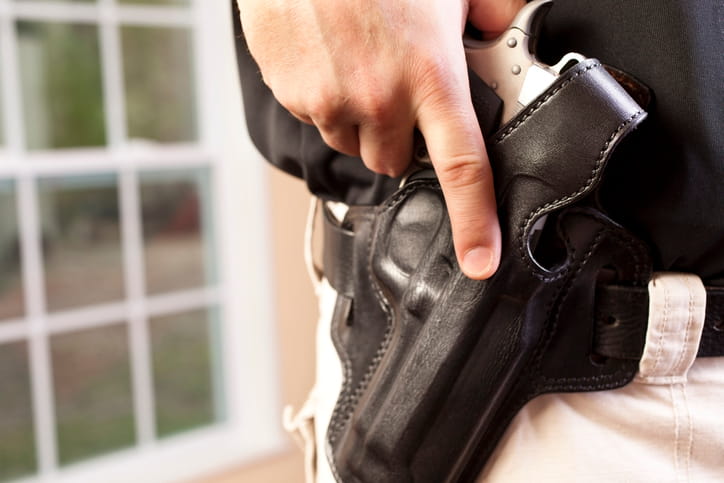
- Holster draw: You are required to draw from the holster prior to each course of fire.
- Marksmanship: You must achieve a score of at least 80% to pass.
In addition to this, Weshoot provides a 2hr class on NJ’s use of force standards, with a written exam at the end, to make sure that all concepts are clearly understood.
There is no remedial instruction if you fail any aspect of the course. It is purely an assessment of your proficiency.
Pre-Qualification Requirements
Before you enroll in the CCARE course, make sure you meet the following requirements:
- 21 years of age or older.
- NJ resident or dual resident.
- Legally permitted to possess a firearm.
- Have a SBI number or FID card
CCARE is not designed for beginners and is a challenging course for those without any recent firearm experience. You should not sign up for the class if it will be your very first time firing a handgun.
If you don’t have recent experience shooting a handgun or drawing from a holster, you should strongly consider taking lessons. A few private lessons with a quality instructor will prepare you to pass the CCARE course of fire on your first attempt. Taking the class without relevant experience is unwise.
Determining if You’re Ready
Do you have some shooting experience but aren’t sure if you are ready for CCARE? While the course is challenging, it is not meant to be intimidating for those with some basic firearms experience.
You are likely ready to take the course if you:
- Can safely handle your firearm, including drawing from the holster.
- Possess consistent accuracy at distances ranging from 3 -15 yards.
- Possess a basic understanding of firearms.
If you have no prior CCW-specific training, a single 2-hour private lesson should adequately prepare you for the CCARE protocol. You should also perform dry-fire practice at home.
Before dry firing, physically and visually inspect your weapon to make sure it is free of any ammunition. Then, practice drawing your weapon from a concealed position roughly 20 to 30 times. Remember, this is not a race. Focus on smoothness and safety, not speed.
Do you feel like you need more time on the range before you sign up for CCARE? Check out WESHOOT and visit our state-of-the-art shooting range. We also offer personalized one-on-one instruction with our experienced training staff.
What To Bring to Your CCW Qualification
Before you head to your class, you need to gather the required gear. At a minimum, you will need the following:
- A handgun in reliable condition.
- 50+ rounds of factory ammunition (no reloads).
- Strong-side hip holster (IWB/OWB only).
- Eye protection.
- Ear protection.
- A sturdy belt.
- Closed-toe shoes.
- A cover garment (i.e., untucked T-shirt).
- Valid photo ID.
- At least two magazines.
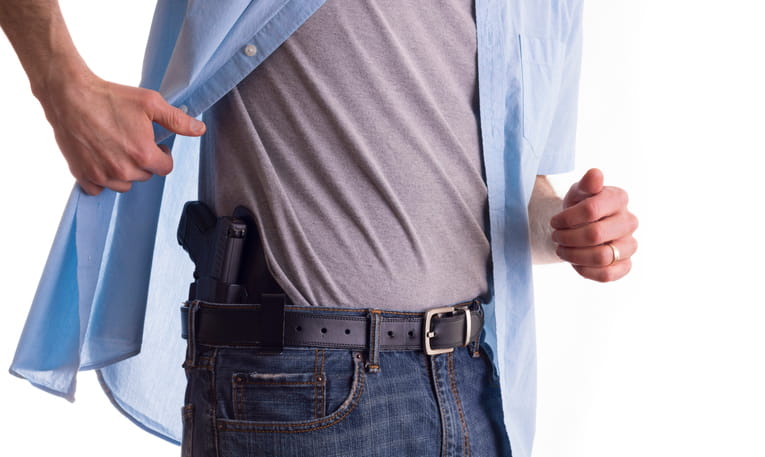
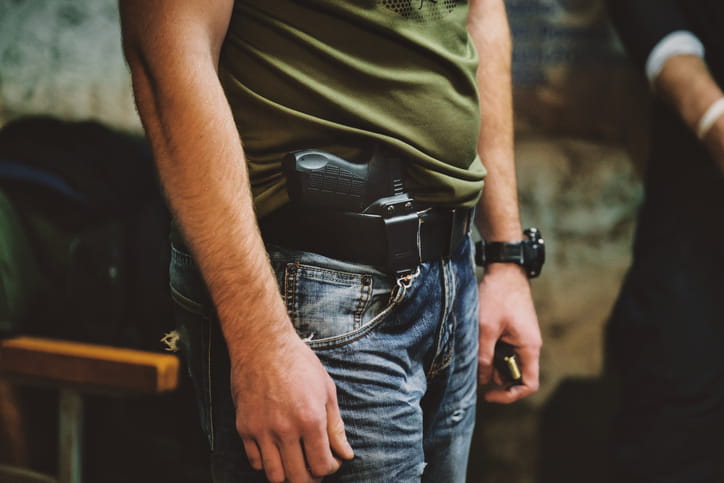
Due to the nature of the training, and to be able to maintain a high level of safety, for the class and shooting qualification, we only allow OWB or Outside the Waist Band Holsters, and depending on your skills, we might allow an IWB or Inside the Waist Band holster, as long as it goes on your hip, in the 3 or 4 position (Lefties can have an 8 or 9 position). The following holsters are specifically prohibited for the class:
- Cross-draw
- Shoulder
- Belly-band
- Ankle
- Appendix carry
If you show up without an approved holster, you will not be allowed to participate in the class. The best way to ensure you have an approved holster is to purchase it from a reputable gun shop that also offers NJ CCP classes. The instructors will help you find a holster that safely holds your handgun so that you can carry with confidence.
Holster Requirements in Detail
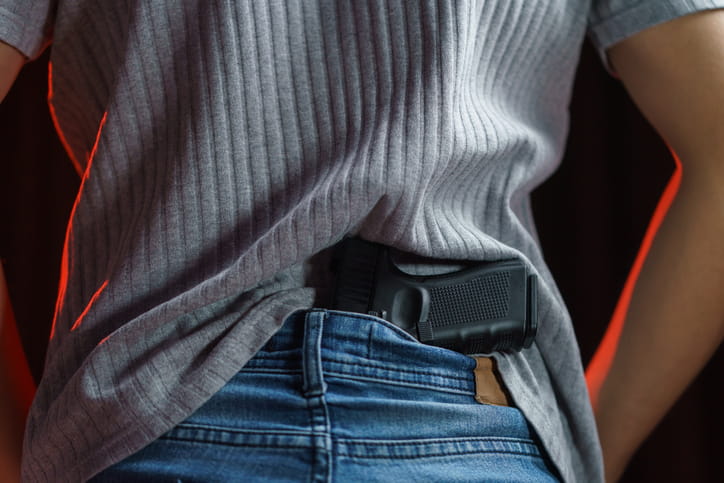
New Jersey requires that you carry your concealed pistol on your strong-side hip, roughly in the 3 – 4 o’clock position. You are allowed to wear either an inside-the-waistband or outside-the-waistband holster, as long as it provides secure retention and allows for safe draws.
Always test the fit and performance of your holster before qualification day. Performing 20 to 30 practice draws with an unloaded weapon will help you determine whether your holster is functioning as designed. It should stay securely attached to your belt when you draw your firearm.
Classroom Instruction: NJ Law and Legal Obligations
While attendees are excited to get on the range, the classroom portion is just as important. What you learn in the classroom will help you safely and lawfully exercise your Second Amendment rights.
The instructors will cover the use of force policy, which includes:
- When deadly force is justified.
- Your duty to retreat when safe to do so.
- Legal consequences of using your firearm.
The instructors will also review New Jersey’s extensive list of sensitive place restrictions, which include:
- Schools
- Government buildings
- Parks
- Courts
- Healthcare facilities
- Beaches
- Places where alcohol is served
- Dispensaries
It is up to you to know where you can and cannot carry your firearm. Bringing your concealed pistol into a sensitive place can result in criminal charges and a revocation of your permit.
Most importantly, you need to adopt a responsible carry mindset. Here are key concepts to adopt:
- A permit is not permission to confront.
- Focus on avoidance.
- Learn to de-escalate first.
Lastly, remember that there are minor permitting differences for NJ vs. dual residents. Your instructor will review these differences during the class.
The 50-Round Shooting Test
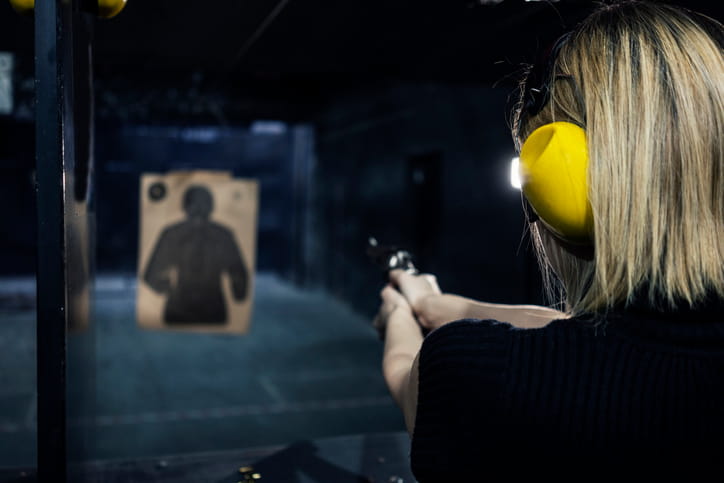
According to the Vineland Police Department, the CCARE course of fire is as follows:
- 10 strings of fire, each of which consists of five rounds.
- You will shoot two strings from each distance.
- Distances include 3, 5, 7, 10, and 15 yards.
- Perform at least one magazine change
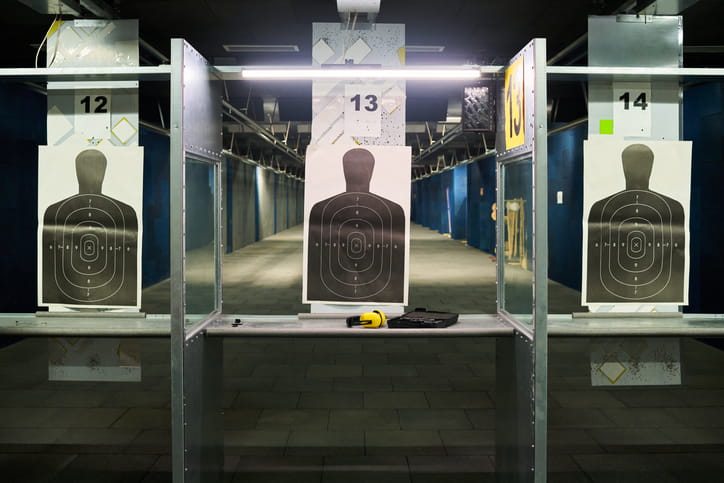
- To pass, you must demonstrate 80% accuracy, which is 40+ hits on an FBI Q target silhouette.
The instructors will also observe your overall weapon handling proficiency and safety. The holster draw involves several essential components, which are:
- Drawing from concealment.
- Safely presenting your firearm on target.
- No muzzle sweeps.
- Controlled reholstering.
To safely reholster your handgun, you must ensure the trigger is clear of any obstructions and that you smoothly place the pistol back in the holster. If needed, you must decock the firearm.
Distance-Based Shooting Performance
You will be shooting from five different distances, each of which requires slightly different skills.
Here’s what to focus on at each distance:
- 3 yard: Quick draw, recoil recovery, and a controlled trigger press.
- 5 – 7 yard medium range: Proper grip and stance, aligned sights, consistency.
- 10 – 15 yard extended range: Steady hand control, a true demonstration of proficiency, and more precision.
The good news is that the CCARE protocol does not include any time restrictions. This removes the pressure to perform movements quickly. Instead, focus on smooth technique and acquiring a clear sight picture before each squeeze of the trigger.
Remember that slow is smooth, and smooth is fast. Work on nailing the mechanics of drawing, shooting, and reholstering your weapon. As you get the basics down, you will get faster with time. But CCARE is not the time to set a personal best score or rush.
Scoring and Passing Standards
You must score at least 40 hits out of 50 rounds. Any rounds that land outside the FBI Q silhouette don’t count. There is no partial credit given during CCARE. Either you pass, or you fail. For example, if you land 39 hits, that’s a fail. If you demonstrate an unsafe handling technique, that’s a fail.
Your instructor will also be observing how you:
- Load
- Unload
- Draw
- Reholster
If you make any egregious safety violations during any of these steps, you could fail the class. If you pass the course, your instructor will provide you with an SP 182 form, which you must submit with your CCW permit application.
Are you ready to complete the CCARE protocol? Learn how to obtain your NJ CCW with WESHOOT.
Qualification Day Logistics
Here’s what you should do and expect when you show up for your NJ CCW qualification:
- Arrive 15 minutes early.
- Plan to spend anywhere from two to six hours in the classroom.
- Lunch break will be scheduled midway through the course.
- Your class will spend two to three hours on the range, which includes a safety briefing.
You will be shooting alongside several of your fellow participants. Depending on the size of the range, 10 to 25 shooters will complete the course simultaneously. Pay close attention to your instructor’s directions, as they will assign you a lane and give synchronized commands to draw, fire, holster, and reload.
Before you start shooting, you will have 15 to 30 minutes of supervised practice to verify your draw and holster technique.
Preparing mentally will set you up for success. Make sure you focus on technique, not speed. Use deep breathing to calm yourself before the live fire drills begin.
Common Disqualifiers
You could be disqualified for:
- Bringing the wrong holster (i.e., cross-draw, appendix).
- Making trigger discipline violations, having a negligent discharge, or other egregious errors.
- Failing to bring the appropriate ammunition.
- Failing to score at least 80%.
The instructors could also fail you if they see signs that you are unfamiliar with your firearm, such as fumbling with the safety or slide release.
What To Do if You Fail the NJ CCW Qualification
If you fail, you will need to:
- Identify and fix your weak areas.
- Attend follow-up training (recommended, not required).
- Pay for and take the full course again.
Most people who fail their first qualification pass on the second attempt. However, they also put in the work to fix their deficiencies.
Post-Qualification: Your Permit Application
After you pass the CCW class and receive your SP 182 form signed by your instructor, you can:
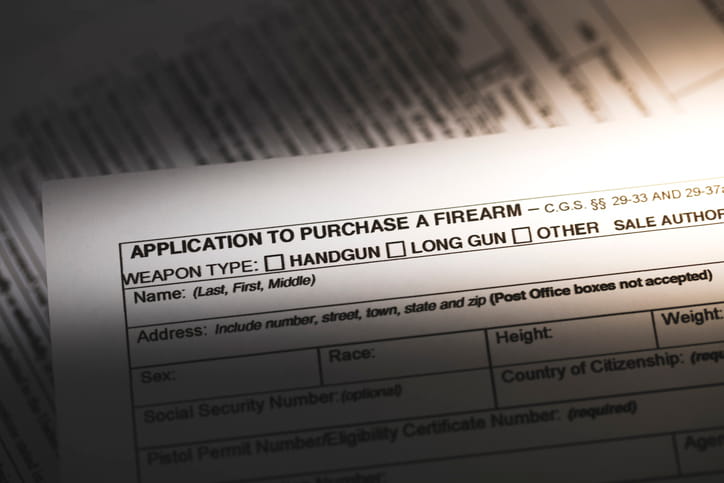
- Submit the form and your full application to the local police.
- Pay your application fee.
- Wait two to six months for your application to be reviewed.
Make sure you retain all of your documents, including your SP 182 and qualification scores.
Key Takeaways
CCARE is not a training class. It is an assessment, which means you need to know the fundamentals before you arrive.
Prepare with:
- Dry-fire practice.
- Private lessons.
- Range time with your specific handgun.
Additionally, make sure you have a compliant holster and work on your marksmanship skills. Scoring a minimum of 80% is non-negotiable.
So, are you ready to get your permit?
WESHOOT has a team of qualified instructors who can help you prepare for CCARE. We also offer a flexible NJ qualification course schedule. Contact us to schedule your NJ CCW class.
FAQ
What Is the NJ CCW Qualification Class Schedule Like?
The specific length of your CCW qualification class will vary, depending on which certifications you are pursuing. Generally, you’ll spend about five to six hours in the classroom and roughly two hours on the range.
Can You Use a Red Dot Optic During the NJ CCARE Qualification and Are There Any Restrictions?
Yes, you can use a red dot during CCARE. As long as your pistol will still fit properly in an approved holster, red dot optics are permitted.
Are Weapon-Mounted Lights (WML) Allowed During NJ CCW Qualification?
Yes, WMLs are allowed during your qualification. However, you may not be allowed to activate the light. Make sure the weapon fits properly in an approved holster before attending the class. Otherwise, you may not be allowed to participate.
Are Compensated/Ported Barrels Allowed During NJ CCW Qualification?
Yes, compensated and ported barrels are permitted, as long as your handgun and holster meet all other requirements. The firearms instructor will inspect your weapon prior to starting the live-fire portion of the class.